.svg)
Understand what is happening broadly in AI – and what it means for your operation
AI is moving quickly and we all need to keep up. In this on-demand webinar, BFC CEO Will Collins breaks down what is broadly happening in the AI world today, where AI is penetrating food service, and the foundational data and processes needed to make AI successful in your operation.
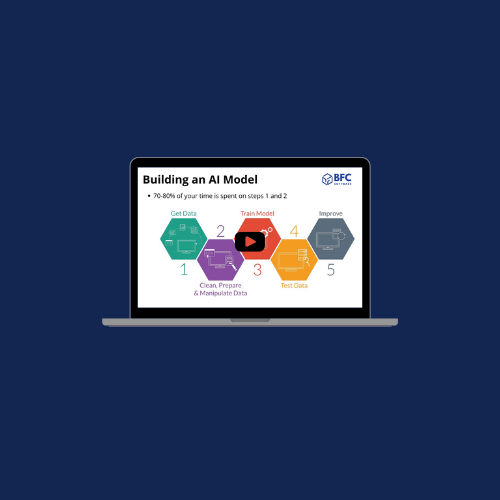
What is happening broadly in the AI world. What is AI, ML, Agentic AI, and what are the steps to building an AI model. Get to know the basics.
Where has AI been the most successful today? See examples from Netflix, Paypal, Apple, and others.
Where AI is starting to penetrate foodservice. What are the 2-3 areas people are actively using today?
Where we are investing at BFC. See 3 areas we are building!
Welcome to our AI in Food Distribution webinar. Good afternoon, everyone, and thank you for joining us. We’ll give folks just a few more seconds to join, but we appreciate you taking the time to be here today. We have a lot to cover, so we’ll move at a good pace. Feel free to drop questions into the Q&A at any time. We’ll also share a few quick polls throughout the session. Let’s get started.
Before we jump into the content, I want to set a bit of context. We’re not here claiming to have all the answers. AI is evolving rapidly, and the landscape is changing quickly. That said, we strongly believe in the power of AI and the outcomes it can drive. We’re investing significant time and resources into understanding where AI is succeeding, where it’s struggling, and how we can apply those learnings to help our customers operate more efficiently and profitably. Here’s what we’ll cover today:
- A quick overview of AI fundamentals
- Where momentum is happening in AI
- Real-world examples of success
- How AI is being applied beyond large language models
- Where we are investing internally
- And how you can prepare for what’s coming next
At a high level, AI is simply computers doing work using advanced algorithms. It typically involves:
- Sophisticated mathematical models
- Large amounts of data
- Specialized hardware like GPUs
I like to think about AI in three main categories:
1. Replacing effort
AI can handle repetitive, low-value tasks—like scheduling meetings or processing simple requests.
2. Scaling effort
AI can perform large-scale analysis or tasks that would take humans hours or days.
3. Augmenting effort
This is where AI becomes “superhuman”—identifying patterns across massive datasets that would be difficult for a human to detect. Building AI models involves several steps:
- Collecting data
- Cleaning and preparing it
- Training the model
- Testing and validating it
- Continuously improving it over time
One key takeaway: Most of the effort—often 70–80%—goes into data preparation, not the model itself.
AI has been around for years, but it’s exploding now due to several factors:
- Faster internet and connectivity
- Cloud computing (AWS, Azure, GCP)
- Massive amounts of stored data
- Easier access to tools and development platforms
These advancements have made AI more accessible and scalable than ever before.
You may have heard the term “agentic AI.”Think of it like a team: Different AI agents handle specific tasks—just like players on a football team—then come together to complete a larger objective.For example, one AI model might analyze sales data, another reviews marketing insights, and a third synthesizes the information into a final recommendation.
There’s a lot of excitement around AI—but also a lot of experimentation. Some studies suggest that up to 95% of AI projects fail. However, when AI works, it can be transformative. Large language models like ChatGPT, Gemini, and Claude are the most visible success stories. They’ve been trained on vast amounts of data and are widely used for:
- Writing and communication
- Research and information retrieval
- Task automation
But AI is expanding far beyond these use cases.
Here are a few examples of AI in action:
- Finance: Automating accounting processes and financial workflows
- Legal: Reviewing contracts and performing legal research
- Internal knowledge: Tools that search company data and answer questions
- Meetings: AI-generated summaries and action items
- Software development: AI-assisted coding tools increasing productivity
Successful AI projects typically share a few characteristics:
- Clean, structured data
- Data stored in the cloud
- Strong contextual understanding
- Human oversight remains essential
Some well-known examples include:
- Netflix: AI-driven recommendation engines
- PayPal: Fraud detection models saving hundreds of millions annually
- Healthcare: AI models improving diagnostic accuracy and accessibility
These examples highlight how AI can drive measurable business outcomes when applied correctly.
So how does this apply to food distribution? Here are some emerging use cases:
- Prospecting: Matching distributor SKUs with restaurant menus
- Order capture: Converting emails, texts, and voicemails into orders
- Smart suggestions: Recommending items based on past purchases
- Quality control: Using computer vision to assess product condition
- Routing optimization: Improving delivery efficiency
These applications reduce manual effort and improve accuracy.
At BFC, we’re investing across our platform:
- Replenishment and forecasting
- Warehouse management
- Transportation optimization
Over the past few years, our primary focus has been building a strong data foundation:-
Capturing detailed operational data
- Moving it to the cloud
- Adding structure and context
This foundation enables meaningful AI applications.
One area we’re excited about is the “virtual analyst.” Instead of manually analyzing data, users can ask questions like:
- “Where should I focus?”
- “Who are my top performers?”
- “What trends should I pay attention to?”
AI can analyze the data and provide insights instantly—often matching or exceeding manual analysis.It can also:
- Identify performance gaps
- Suggest actions
- Generate visualizations
- Deliver daily summaries automatically
We’re also applying AI to slot optimization. Traditionally, this requires manual analysis of:
- Replenishment frequency
- Pick patterns
- Product movement
AI can:
- Identify inefficiencies
- Recommend slot changes
- Detect seasonal trends
- Optimize warehouse layout
This dramatically reduces the time required for analysis while improving accuracy.
Another area is truck building. We’re experimenting with AI models that:
- Optimize load configurations
- Balance weight distribution
- Learn from user behavior
- Improve planning efficiency over time
The goal is to replicate human decision-making—faster and more consistently.
So what should you be doing today?
1. Capture your data
Ensure your systems track operational activity consistently.
2. Move data to the cloud
AI requires scalable, accessible data infrastructure.
3. Understand your data
Define KPIs, document processes, and analyze performance regularly.
4. Add context
Store documentation, insights, and historical learnings.
5. Start experimenting
Use AI tools and build familiarity across your organization.AI will not replace humans—but it will enhance how we work.
AI is still in an early phase.We expect:
- Continued experimentation over the next 6–12 months
- More mature solutions within 2–3 years
- Significant operational impact over time
Organizations that invest in data and infrastructure today will be best positioned to take advantage.
Thank you again for joining us today.If you’re exploring cloud WMS, analytics, or AI initiatives, we’d love to connect. Visit bfcsoftware.com or reach out to schedule a conversation. We’re excited to be on this journey with you. Thanks again, and have a great day.