.svg)
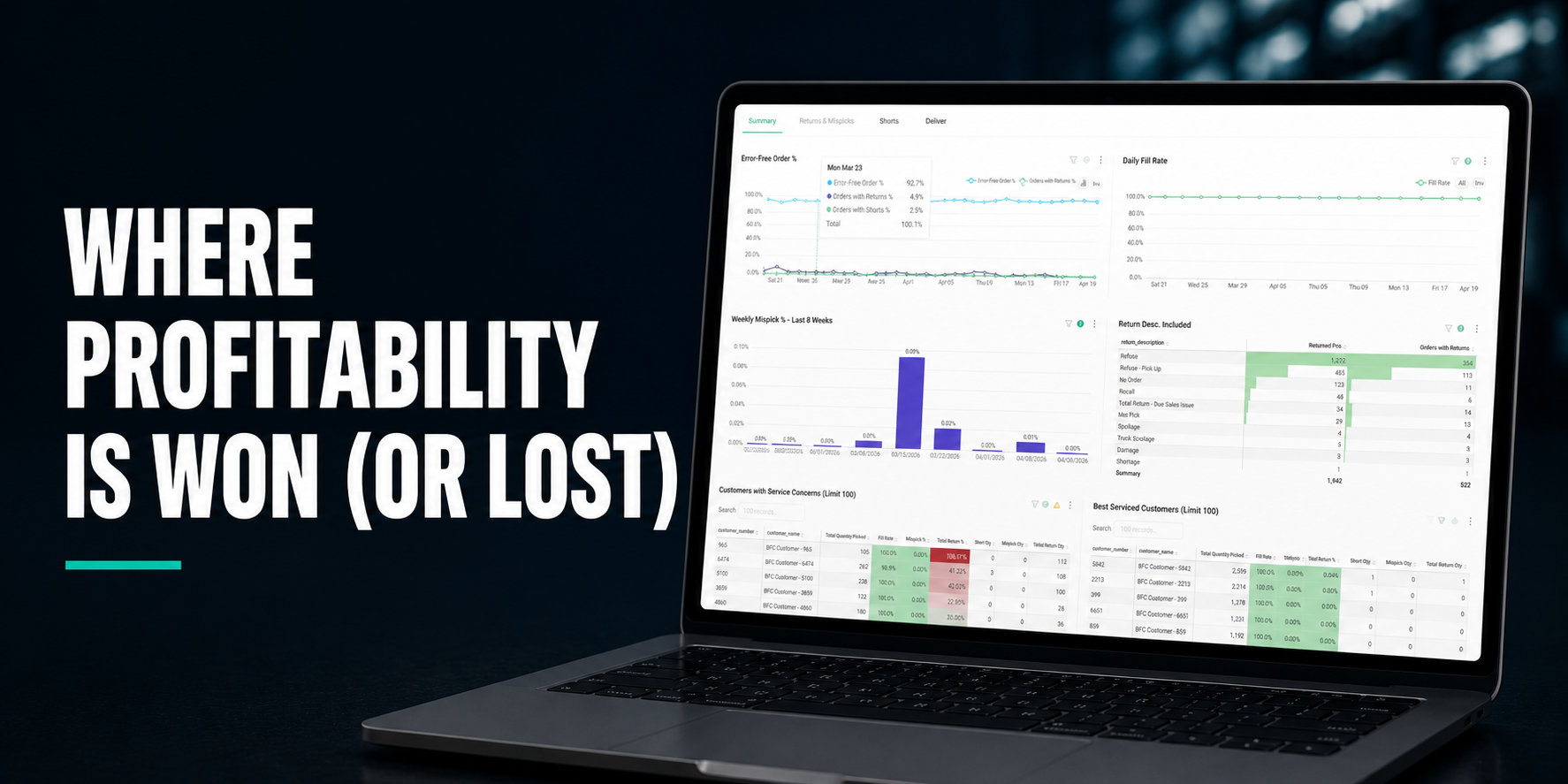

Food distribution is changing rapidly. What once worked—relying on experience, hustle, and volume—is no longer enough to sustain margins. Today’s most profitable operations are shifting toward a different model: one built on data, visibility, and continuous improvement.
Many warehouses still depend heavily on a few experienced operators to make decisions. While effective in the short term, this approach doesn’t scale. As operations grow more complex—with more SKUs, tighter delivery expectations, and increased compliance requirements—decision-making must become more structured.
Leading distributors follow a consistent loop:
Over time, this cycle creates a compounding advantage. Each iteration improves performance, driving both efficiency and profitability.
Analytics becomes most valuable when applied to core warehouse functions. Three areas consistently stand out:
1. Labor Productivity
Labor is one of the largest controllable costs in a warehouse. Yet many operations lack a clear, real-time view of productivity.
When distributors begin tracking cases per hour, benchmarking performance, and reviewing trends over time, they often uncover wide variation across individuals or zones. Addressing these gaps—through training, process adjustments, or better tools—can significantly increase throughput without adding headcount.
Even moderate improvements in productivity can translate into meaningful cost savings and improved capacity utilization.
2. Errors and Mispicks
Small error rates can have outsized financial impact. A single mispick doesn’t just affect one order—it creates downstream costs in returns, credits, and customer dissatisfaction.
The key is visibility. By tracking scan performance, identifying error-prone items or workflows, and drilling into root causes, warehouses can systematically reduce errors. Often, simple fixes—like reinforcing scanning processes or addressing product data issues—deliver immediate results.
Over time, reducing errors protects margin and improves customer trust.
3. Service Levels and “Hidden Revenue”
Shorts—orders that can’t be fulfilled—are another major source of lost profitability. These are often treated as unavoidable, but in reality, many are preventable.
By analyzing trends and segmenting shorts into categories (inventory, replenishment, or purchasing issues), operators can take targeted action. Even small improvements in fulfillment rates can unlock significant revenue that would otherwise be lost.
In high-volume environments, incremental gains here can have a substantial financial impact.
One of the biggest barriers to improvement isn’t effort—it’s clarity.
When teams have a single, trusted view of performance, behavior changes. Managers can identify issues faster. Teams can track progress. Conversations shift from opinions to facts.
In practice, organizations that move from periodic reviews to consistent, data-driven performance management often see rapid improvements—especially when focusing on underperforming areas first.
Analytics is not a one-time project—it’s a capability.
The most effective organizations:
This creates a culture where improvement is ongoing, not reactive. Over time, operations become more predictable, scalable, and efficient.
The future of food distribution will be driven by intelligence—systems that not only report on performance but help guide decisions in real time.
But that future starts with fundamentals: clean data, clear processes, and a commitment to using insights to drive action.
For warehouse leaders, the opportunity is clear: those who embrace analytics will not only operate more efficiently—they’ll build a lasting competitive advantage.
Click here to watch a short video to learn more about BFC Analytics today.









.png)


