.svg)


Many industries deal in widgets — products that leave a warehouse exactly as they arrive. Food doesn’t play by those rules. Food is dynamic. It ages by the hour, reacts to its environment, and carries strict safety, compliance, and handling requirements at every step. One misstep doesn’t just delay a shipment—it can erode margins, damage customer trust, or trigger regulatory risk.
The software built for general distribution were designed for predictability. Food is anything but predictable. Understanding why food is different is the first step to understanding why the way you run your operation—and what you run it on—matters more than most people realize.
No other consumer product has an expiration date baked into its identity quite like food does. A television doesn't spoil. A pair of jeans doesn't go bad. But a pallet of strawberries has a clock ticking from the moment it's harvested — and every link in the supply chain either preserves or accelerates that countdown.
Perishability forces a fundamentally different relationship with inventory. FIFO (or FEFO) isn't a best practice in food — it's a survival strategy. Waste isn't just a margin problem; it's a safety problem. And the ripple effects are felt everywhere: in how warehouses are designed, how orders are sequenced, how suppliers are evaluated, and how receiving decisions get made.
It also means that stale data is a real operational risk. Yesterday's inventory count may be meaningfully wrong today — and acting on it has consequences that most industries simply don't face.
Temperature is perishability's operating system. Where most goods only need to avoid extreme conditions, food often requires precise ones — and those requirements don't pause when product moves from one part of the operation to another.
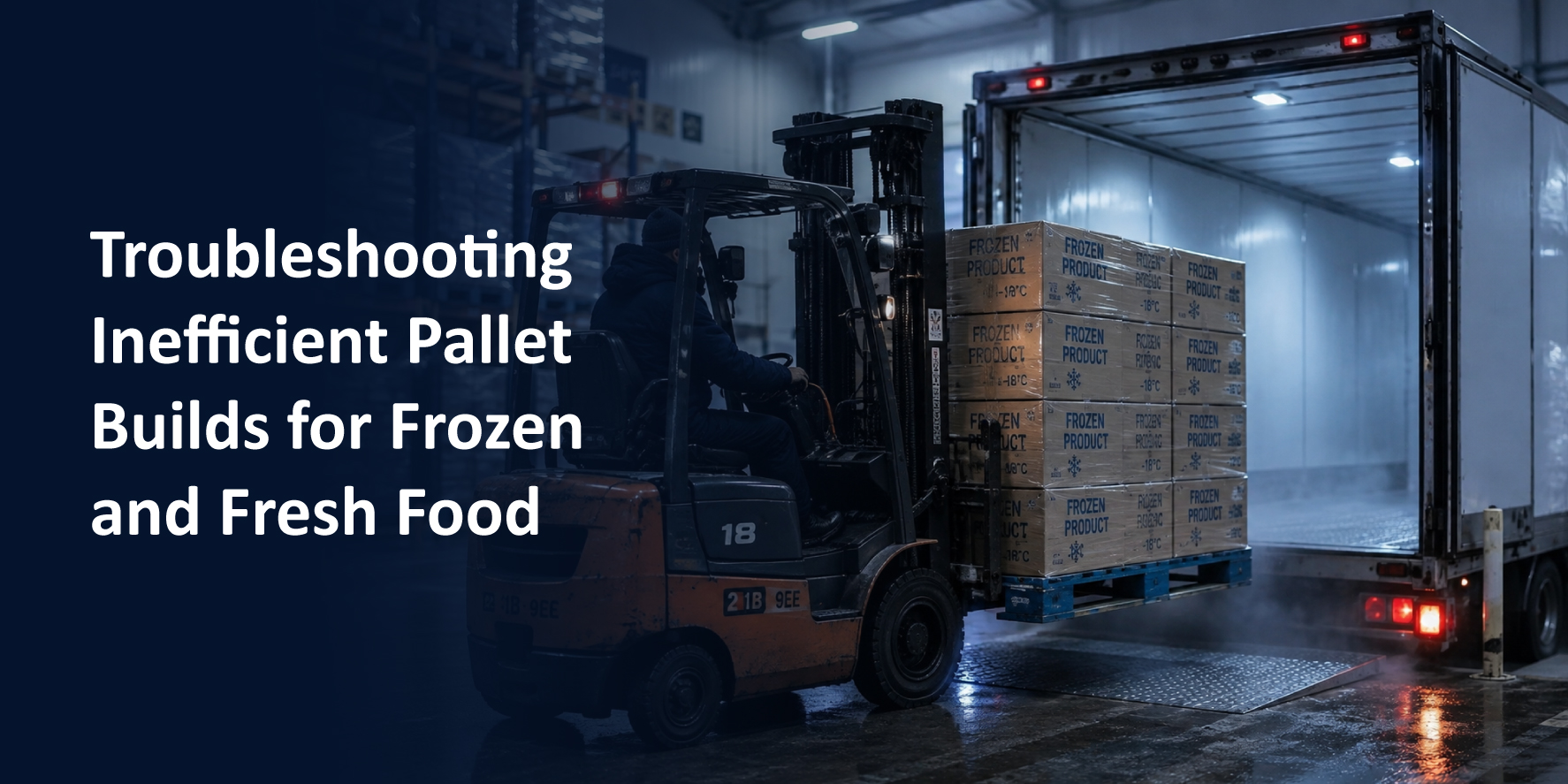
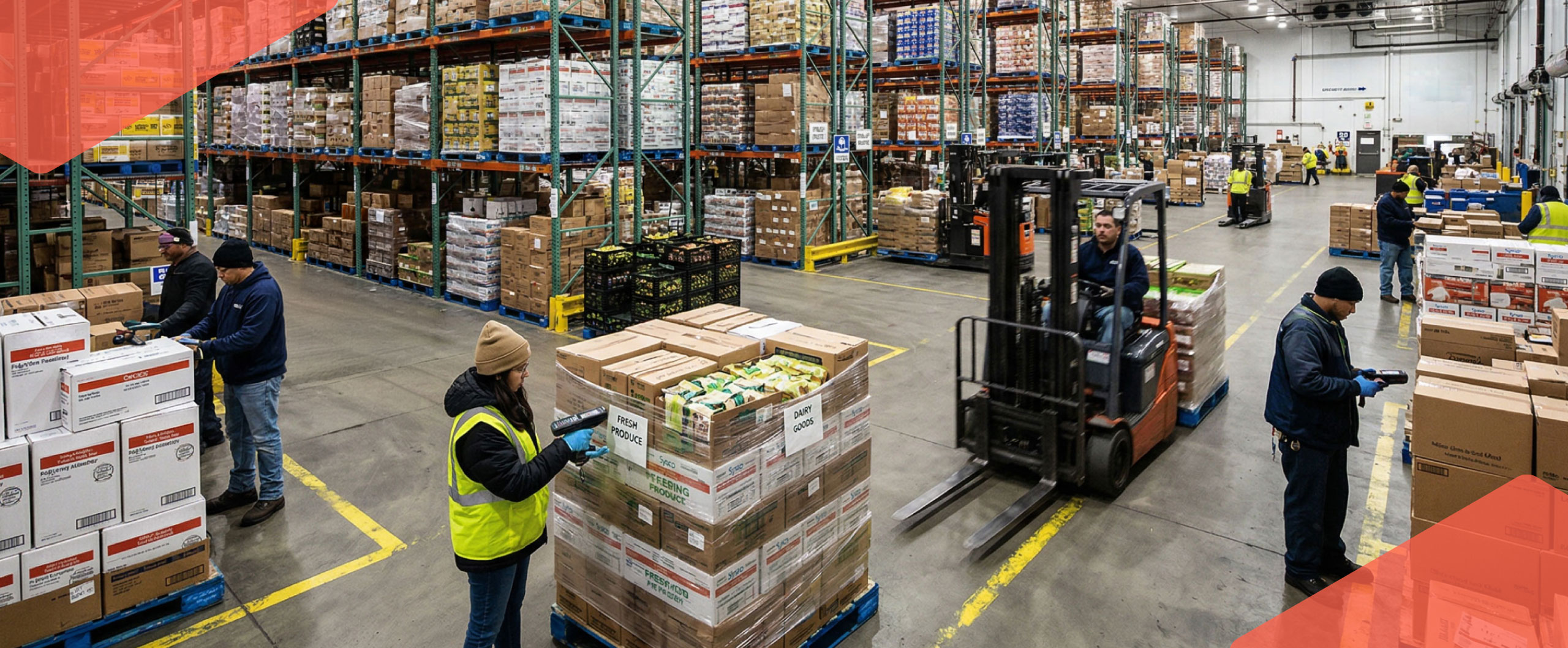
A single facility might manage ambient dry storage, refrigerated zones for produce and dairy, and deep-freeze environments for proteins and ice cream, all under one roof. That complexity doesn't end at the dock door. Inbound receiving requires temperature verification before product ever touches a slot. Outbound delivery means pre-conditioned trucks, route sequences that account for dwell time, and cold chain documentation that survives the last mile.
The moment temperature control breaks down anywhere along that chain — in the warehouse, in staging, or on the truck — perishability accelerates fast. Cold chain integrity isn't just an operational concern. It's a regulatory and liability one.
For operations running mixed loads of ambient, refrigerated, and frozen product, nearly every fulfillment decision — pick sequencing, load building, delivery routing — has a temperature dimension baked in. Systems that weren't built with that in mind tend to show their limits quickly.
Ask someone how many units of lumber they have and they'll get you a clean answer. Ask someone how many units of cheese they have, and suddenly you're having a much more interesting conversation.
Food is bought, sold, stored, and consumed in a dizzying array of units — and they don't always map neatly onto each other. A supplier sells by the case. A retailer receives by the pallet. The consumer buys by the pound. The nutritional label speaks in grams. The recipe calls for cups. Somewhere in the middle, an operation is trying to track all of this simultaneously and keep the numbers straight.
Variable-weight items add another layer. A chicken breast doesn't weigh exactly 6 oz every time. A wheel of parmesan doesn't come in perfectly uniform rounds. Catch-weight items — sold by count but priced by weight — require a level of precision that most general-purpose systems were never designed to handle.
Getting units of measure right in food isn't a configuration detail. It's foundational to inventory accuracy, margin integrity, and customer trust.
Most products enter a warehouse as one thing and leave as that same thing. Food doesn't always follow that rule.
Food gets transformed. A raw chicken becomes a seasoned, portioned, packaged product. A bin of apples becomes a case of applesauce. Ingredients become meals.
This transformation creates traceability challenges that pure distribution operations don't face: How do you track lineage from raw input to finished output? How do you allocate costs across a yield that varies batch to batch? What happens to lot tracking when a single ingredient appears across 40 different SKUs?
For the systems running these operations, transformation means the underlying data model has to accommodate things that standard transactional software wasn't built for — bill-of-materials relationships, production orders, yield variance, and lot genealogy. Operations that try to force that complexity into tools designed for simpler flows tend to end up bridging the gaps with spreadsheets and workarounds.
Walk into a modern e-commerce fulfillment center and you'll see a significant amount of robotics. Walk into most food distribution operations and you'll see people — and for good reason. The SKU variety in food, combined with the demands of temperature-zoned storage, makes the environment fundamentally harder to automate. Cases aren't uniform. Products have different handling requirements. Freezer environments push the limits of most robotic systems. As a result, food distribution remains one of the more labor-intensive operations in the supply chain world, and that's unlikely to change dramatically anytime soon.
This has real implications for how operations need to be run and supported. When labor is your primary execution resource, the tools, workflows, and visibility you give your team matter enormously. Efficiency isn't something you automate your way into — it's something you have to build into every process.
Food is one of the most heavily regulated categories of commerce in the world — and for good reason. The consequences of getting it wrong aren't a chargeback or a bad review. They're a recall, a public health event, or an FDA action.
Compliance in food touches nearly every operation: labeling requirements, allergen declarations, country-of-origin rules, organic and non-GMO certifications, FSMA traceability mandates, and temperature logging for audits. The regulatory environment varies by product type, channel, and geography — and it evolves.
What makes compliance especially unforgiving is that it can't be bolted on after the fact. Lot tracking, document retention, supplier certification management, and recall execution capability have to be designed into the operation from the start. Finding out your systems can't support a regulatory requirement during an audit is a costly way to learn the lesson.
Food looks simple on the surface — it's something everyone understands intuitively. But beneath that familiarity is a category of genuine operational complexity that touches every part of the business: buying, warehousing, and delivery.
Each of these six characteristics demands something specific from the people, processes, and tools running a food distribution operation. In a follow-up post, we'll look at where that complexity tends to surface — and where the cracks show up in systems that weren't built with food in mind.
Want to learn more about how BFC Warehouse Management compares to what your're using today? Check your untapped potentail with our simple savings calculator.







.png)


